Ask about our free Pilot2Partnership program
Learn more

Product
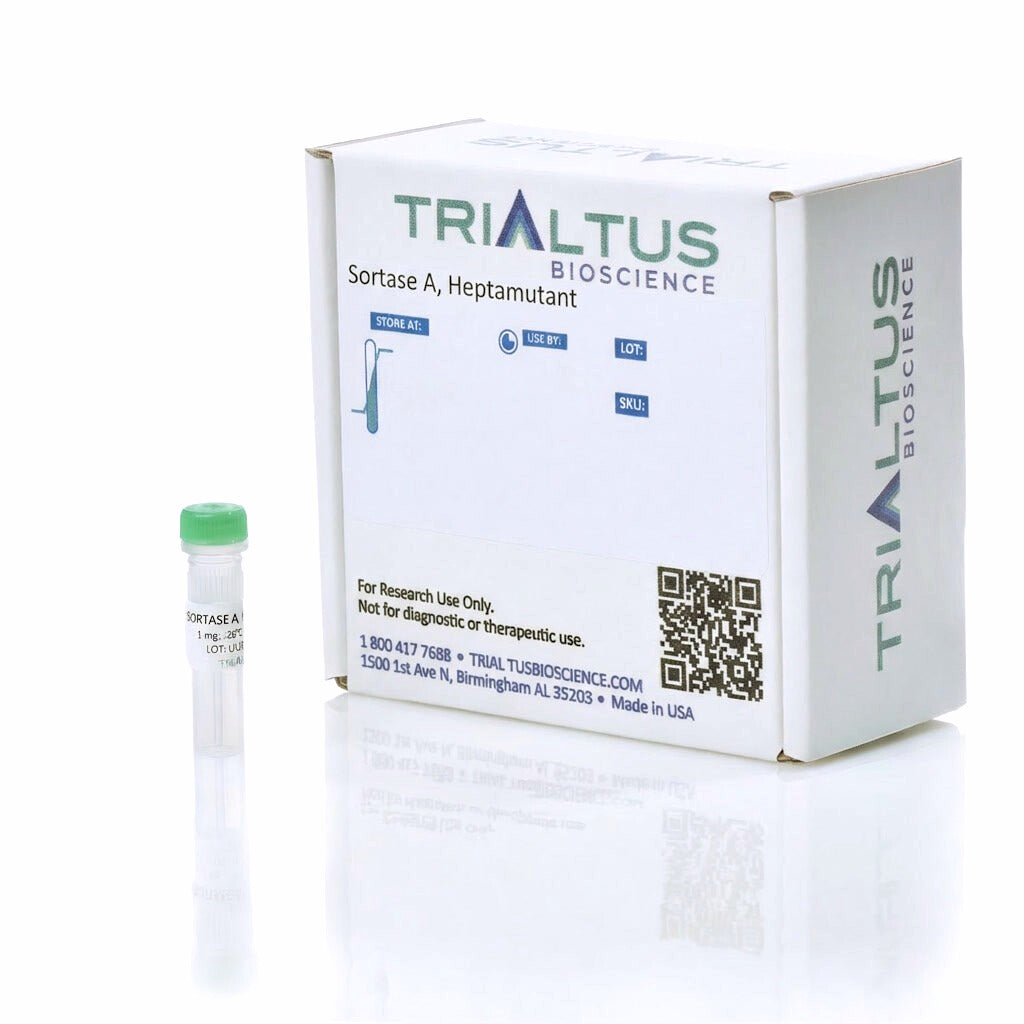
Sortase A, Heptamutant (Tag-Free)
$375
Quantity
Buy in Bulk
Quantity
Buy in Bulk
Specifications
Data Sheets
Similar Products
Shipping
Buy Now
Overview
Sortase A, Heptamutant (Tag-Free) is an engineered enzyme from Staphylococcus aureus (mutations P94R, D160N, D165A, Y187L, E189R, K190E, K196T) designed for site-specific protein modification and ligation. This heptamutant variant is calcium-independent, supporting use in intracellular and extracellular contexts where calcium dependence is undesirable. Applications include site-specific protein labeling, antibody modification, protein circularization, and live-cell surface conjugation with molecules such as fluorescent dyes, biotin, and nucleic acids.
Also known as: Sortase A heptamutant, tag-free Sortase A, S. aureus Sortase A heptamutant, Sortase A 7M, SrtA7m
Why Purity and Consistency Matter for Sortase A (Heptamutant)
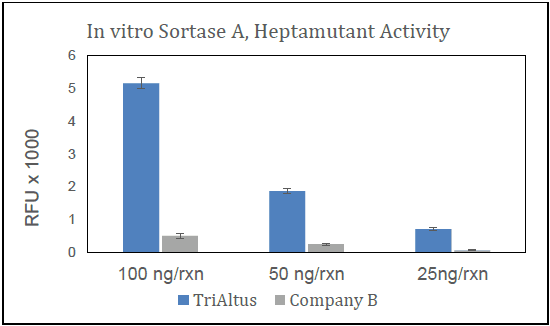
Sortase-mediated conjugation workflows are sensitive to enzyme purity and lot-to-lot consistency because impurities can increase background reactions and introduce variability across batches. High-purity, well-controlled preparations support predictable ligation outcomes and more consistent performance when protocols are standardized across teams, constructs, and time.
Bulk Supply & Program Support
TriAltus supports bulk supply and tailored formats for organizations that require dependable, long-term access to Sortase A for standardized conjugation workflows. Volume-based pricing is available to support program-scale demand and cost-of-goods targets. Production under ISO 13485–compliant processes and the CLīM™ purification platform enable batch consistency and efficient cost-of-goods at scale, supporting volume-based pricing for sustained programs. Contact TriAltus to discuss volume requirements, documentation needs, packaging preferences, and to request a quote.
Key Benefits
Calcium-independent Sortase A heptamutant supports broader buffer and workflow flexibility
Tag-free format for reduced risk of tag-driven interactions
Engineered heptamutant sequence (P94R, D160N, D165A, Y187L, E189R, K190E, K196T)
Purity ≥95% (SDS-PAGE)
Specifications
PURITY | ≥95%
ENZYME SOURCE | Staphylococcus aureus Sortase A, Heptamutant is expressed in E. coli and is purified with our CLīM technology.
STORAGE/SHIPPING CONCENTRATION | ~ 1 mg/mL
STORAGE BUFFER | 10 mM Tris HCl pH 8.0, 250 mM NaCl, 0.5 mM TCEP, 50% glycerol
RECOMMENDED STORAGE CONDITIONS | -80°C
EXPIRATION | 6 months from receipt when stored as directed. Avoid repeated freeze/thaw cycles.
Produced under ISO 13485–compliant processes.
Sortase A, Heptamutant (Tag-Free) Data Sheet
SKU List
100 µg: 40-2320 | 500 µg: 40-2325 | 1 mg: 40-2330 | Bulk: Inquire
Applications
ADC research and site-specific antibody conjugation
Used to create defined antibody conjugates by attaching payloads or linker handles at engineered sites, supporting ADC method development where controlled conjugation and reproducible product profiles are priorities.
Protein bioconjugation for assay development
Supports installation of labels (e.g., fluorescent dyes, biotin, oligos) at defined positions to improve assay consistency and reduce heterogeneity compared to non-specific labeling.
Protein–protein ligation and modular construct generation
Enables assembly of defined fusion proteins for discovery programs that require rapid build–test cycles and standardized constructs.
Live-cell surface conjugation and surface immobilization
For labeling or conjugation at cell surfaces or functional surfaces, calcium independence can make protocol design simpler by avoiding the need to introduce Ca²⁺ during conjugation steps, depending on the system.
Learn More
View the His-tagged Sortase A heptamutant for workflows that prefer affinity-tag handling.
Learn how TriAltus achieves high purity with CLīM™ purification.
See peer-reviewed publications supporting the platform.
Compare alternative tag-cleavage tools on PreScission Protease and SUMO Protease pages
FAQs
What does “tag-free” mean, and when is it the right choice?
“Tag-free” means the Sortase enzyme itself is supplied without an affinity tag (e.g., His-tag). That’s useful when you’re running conjugations where extra tags could increase non-specific binding in downstream steps (like antibody workflows, surface conjugation, or analytical assays). If your workflow benefits from affinity handling (e.g., capture/polish steps or quick cleanup), you may prefer the His-tagged Sortase A heptamutant version.
Can I use this enzyme for site-specific antibody conjugation (including ADC method development)?
Yes. Sortase-mediated antibody conjugation is a well-established approach for generating site-specific conjugates, and it has been used to create homogeneous ADC formats with controlled attachment sites and defined drug-to-antibody ratios in published methods and studies.
What do I need to engineer into my substrate to use Sortase A?
In the most common Sortase A format, you design an LPXTG motif (often LPETG) on the C-terminus of your “acyl donor” protein, and you provide an oligoglycine nucleophile (e.g., GGG or G₅) on the “acceptor” molecule (a peptide, protein, label, or payload). Sortase cleaves between T and G in LPXTG and ligates the donor to the N-terminal glycine of the acceptor.
Example design: Protein–LPETG + GGG–fluorophore → site-specific labeled protein.
Example ADC-style concept: an antibody engineered with an LPETG tag can be conjugated to a pentaglycine-modified payload/handle using Sortase-mediated conjugation.
Overview
Sortase A, Heptamutant (Tag-Free) is an engineered enzyme from Staphylococcus aureus (mutations P94R, D160N, D165A, Y187L, E189R, K190E, K196T) designed for site-specific protein modification and ligation. This heptamutant variant is calcium-independent, supporting use in intracellular and extracellular contexts where calcium dependence is undesirable. Applications include site-specific protein labeling, antibody modification, protein circularization, and live-cell surface conjugation with molecules such as fluorescent dyes, biotin, and nucleic acids.
Also known as: Sortase A heptamutant, tag-free Sortase A, S. aureus Sortase A heptamutant, Sortase A 7M, SrtA7m
Why Purity and Consistency Matter for Sortase A (Heptamutant)
Sortase-mediated conjugation workflows are sensitive to enzyme purity and lot-to-lot consistency because impurities can increase background reactions and introduce variability across batches. High-purity, well-controlled preparations support predictable ligation outcomes and more consistent performance when protocols are standardized across teams, constructs, and time.
Bulk Supply & Program Support
TriAltus supports bulk supply and tailored formats for organizations that require dependable, long-term access to Sortase A for standardized conjugation workflows. Volume-based pricing is available to support program-scale demand and cost-of-goods targets. Production under ISO 13485–compliant processes and the CLīM™ purification platform enable batch consistency and efficient cost-of-goods at scale, supporting volume-based pricing for sustained programs. Contact TriAltus to discuss volume requirements, documentation needs, packaging preferences, and to request a quote.
Key Benefits
Calcium-independent Sortase A heptamutant supports broader buffer and workflow flexibility
Tag-free format for reduced risk of tag-driven interactions
Engineered heptamutant sequence (P94R, D160N, D165A, Y187L, E189R, K190E, K196T)
Purity ≥95% (SDS-PAGE)
Specifications
PURITY | ≥95%
ENZYME SOURCE | Staphylococcus aureus Sortase A, Heptamutant is expressed in E. coli and is purified with our CLīM technology.
STORAGE/SHIPPING CONCENTRATION | ~ 1 mg/mL
STORAGE BUFFER | 10 mM Tris HCl pH 8.0, 250 mM NaCl, 0.5 mM TCEP, 50% glycerol
RECOMMENDED STORAGE CONDITIONS | -80°C
EXPIRATION | 6 months from receipt when stored as directed. Avoid repeated freeze/thaw cycles.
Produced under ISO 13485–compliant processes.
Sortase A, Heptamutant (Tag-Free) Data Sheet
SKU List
100 µg: 40-2320 | 500 µg: 40-2325 | 1 mg: 40-2330 | Bulk: Inquire
Applications
ADC research and site-specific antibody conjugation
Used to create defined antibody conjugates by attaching payloads or linker handles at engineered sites, supporting ADC method development where controlled conjugation and reproducible product profiles are priorities.
Protein bioconjugation for assay development
Supports installation of labels (e.g., fluorescent dyes, biotin, oligos) at defined positions to improve assay consistency and reduce heterogeneity compared to non-specific labeling.
Protein–protein ligation and modular construct generation
Enables assembly of defined fusion proteins for discovery programs that require rapid build–test cycles and standardized constructs.
Live-cell surface conjugation and surface immobilization
For labeling or conjugation at cell surfaces or functional surfaces, calcium independence can make protocol design simpler by avoiding the need to introduce Ca²⁺ during conjugation steps, depending on the system.
Learn More
View the His-tagged Sortase A heptamutant for workflows that prefer affinity-tag handling.
Learn how TriAltus achieves high purity with CLīM™ purification.
See peer-reviewed publications supporting the platform.
Compare alternative tag-cleavage tools on PreScission Protease and SUMO Protease pages
FAQs
What does “tag-free” mean, and when is it the right choice?
“Tag-free” means the Sortase enzyme itself is supplied without an affinity tag (e.g., His-tag). That’s useful when you’re running conjugations where extra tags could increase non-specific binding in downstream steps (like antibody workflows, surface conjugation, or analytical assays). If your workflow benefits from affinity handling (e.g., capture/polish steps or quick cleanup), you may prefer the His-tagged Sortase A heptamutant version.
Can I use this enzyme for site-specific antibody conjugation (including ADC method development)?
Yes. Sortase-mediated antibody conjugation is a well-established approach for generating site-specific conjugates, and it has been used to create homogeneous ADC formats with controlled attachment sites and defined drug-to-antibody ratios in published methods and studies.
What do I need to engineer into my substrate to use Sortase A?
In the most common Sortase A format, you design an LPXTG motif (often LPETG) on the C-terminus of your “acyl donor” protein, and you provide an oligoglycine nucleophile (e.g., GGG or G₅) on the “acceptor” molecule (a peptide, protein, label, or payload). Sortase cleaves between T and G in LPXTG and ligates the donor to the N-terminal glycine of the acceptor.
Example design: Protein–LPETG + GGG–fluorophore → site-specific labeled protein.
Example ADC-style concept: an antibody engineered with an LPETG tag can be conjugated to a pentaglycine-modified payload/handle using Sortase-mediated conjugation.
Do prices include shipping and handling?
What is your turnaround time?