Ask about our free Pilot2Partnership program
Learn more

The Hidden Cost of Conventional Affinity Tags
Protein purification shouldn't force you to choose between yield and function. Yet researchers routinely accept activity loss, batch-to-batch variability, and complex workflows-particularly when purifying membrane proteins, DNA-binding targets, or cofactor-dependent enzymes.
There's a better way.
The Hidden Cost of Conventional Affinity Tags
Traditional purification systems-His-tag, GST, Strep-tag-impose constraints that compromise protein integrity:
Buffer incompatibility. Narrow pH and salt tolerance limits your ability to maintain optimal conditions for delicate proteins.
Non-specific binding. Contaminants from host cell proteins and nucleic acids persist through washes, reducing final purity.
Multi-step stress. Repeated binding, washing, and elution cycles expose proteins to denaturation, aggregation, and proteolytic degradation.
For complex enzymes and multi-subunit assemblies, these limitations don't just reduce yield- they introduce functional variability that undermines reproducibility and complicates downstream applications.
The TriAltus Solution: Ultra-Stable, Single-Step Purification
The CL7/Im7 ultra-high-affinity system was developed to overcome the limitations of traditional purification tags. This next-generation platform excels with:
Membrane proteins requiring detergent compatibility
DNA/RNA-binding proteins needing high-salt conditions
Multi-subunit complexes sensitive to dissociation
Enzymes requiring specific cofactors or redox environments
Why CL7/Im7 Outperforms Traditional Tags
Exceptional tolerance. Maintains binding integrity across extreme conditions- up to 4M NaCl, diverse detergents (DDM, Triton X-100), and broad pH ranges (pH 4-10).
Near-covalent affinity. With Kd values of 10⁻¹⁴–10⁻¹⁷ M, the CL7/Im7 interaction rivals covalent bonds—enabling stringent washes without target loss.
Single-step purity. Achieve >95–99+% purity in one elution, with on-column tag cleavage for native protein recovery.
Preserved structure and function. Gentle elution conditions maintain native folding and enzymatic activity.
This combination enables you to optimize purification conditions for your protein—not compromise protein function for your purification system.
Proven Performance: Sortase A, Heptamutant Case Study
Sortase A (heptamutant) is a workhorse enzyme for site-specific protein conjugation. Standard His-tag purification delivers acceptable yields but inconsistent activity, a critical problem when enzymatic efficiency directly impacts experimental outcomes.
TriAltus CL7/Im7 results:
>10-fold increase in specific enzymatic activity compared to conventional purification
Single-step recovery with preserved native structure
ISO 13485-compliant reproducibility for scalable production
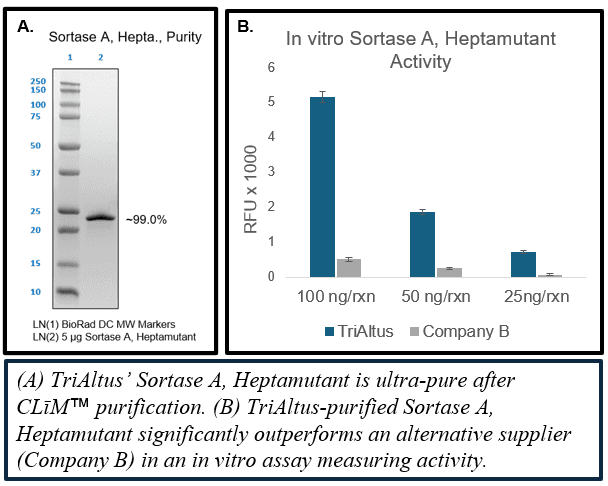
This activity enhancement translates directly to improved ligation efficiency, reduced enzyme consumption, and more reliable assays.
Purify Challenging Proteins with Confidence
From CRISPR tools to internally deployed workhorse enzymes, TriAltus helps you scale protein production- without compromising activity or purity. TriAltus delivers what matters most: functionally intact proteins that perform consistently.
Ready to eliminate purification compromises? Contact TriAltus to discuss your specific protein challenges.